
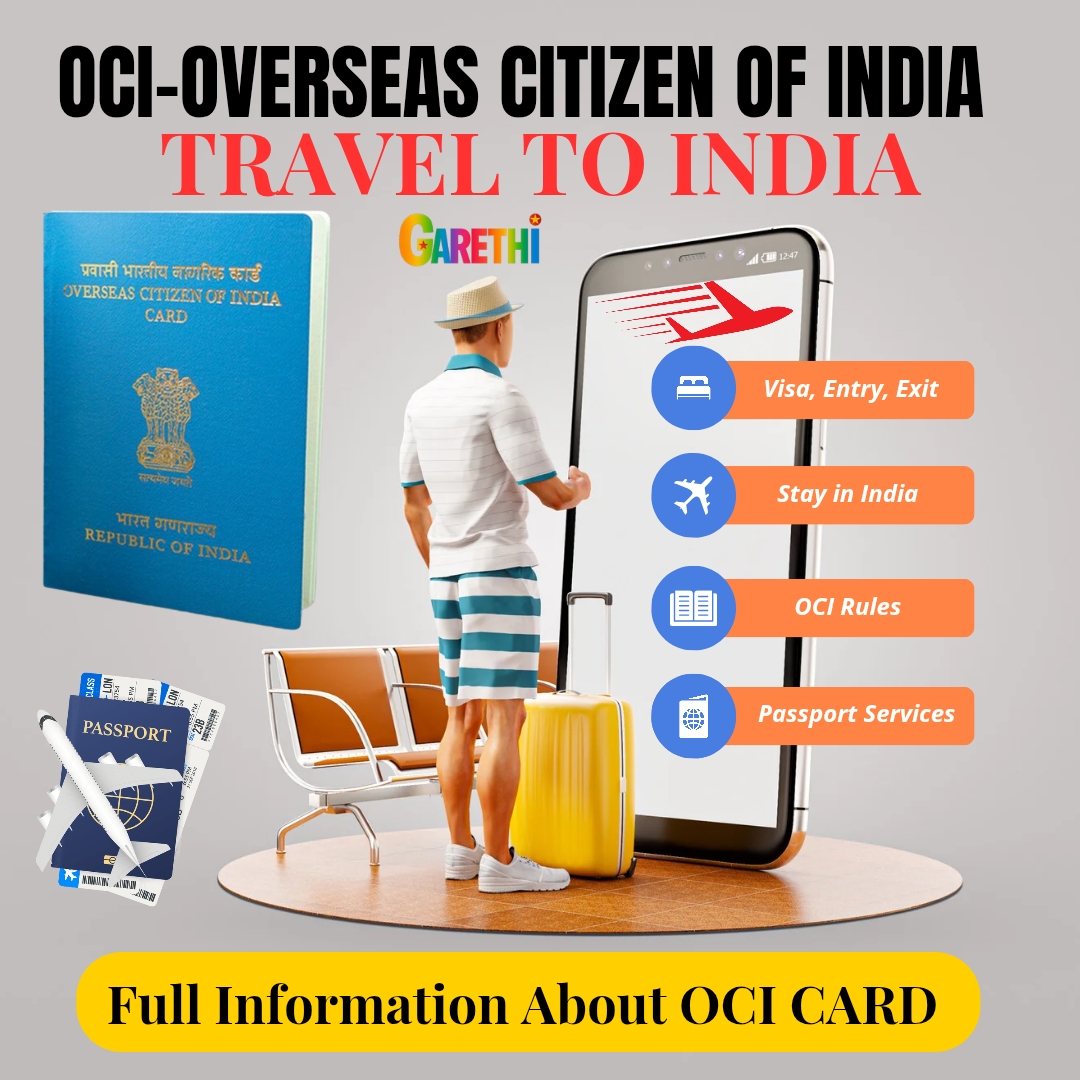
OCI – Overseas Citizen of India
The OCI card is a lifelong visa and residency option for people of Indian origin who have acquired foreign citizenship January 26, 1950, allowing them to maintain close ties with India. Citizens OR origin of Pakistan and Bangladesh are not eligible. Refugees and Asylees: Those holding refugee, stateless, or asylee status in any country are not eligible for OCI
Eligibility of OCI CARD
- You can apply for an OCI card if you.
- Are a former Indian citizen who has acquired foreign citizenship.
- Were a citizen of India on or after January 26, 1950.
- Are a child, grandchild, or great-grandchild of a former Indian citizen.
- Are a minor child of an OCI cardholder.
Travel Information
- Anyone with an OCI card can travel at any time. No other visa is required.
- A physical OCI card must be presented for entry into India. Mobile phones or photocopies will not be accepted.
- OCI This is a lifelong visa. It does not expire.
- The OCI is updated periodically to ensure the identity of the individual. A new OCI application must be made at the age of 20 and 50. This is an update process.
- OCI holders are required to complete biometric and immigration forms at the time of entry at Any Airport or Land ICP.
- OCI visa holders can stay in India unlimited. No registration or exit permit is required.
- Anyone who has applied for OCI but has not yet received it will need to obtain a visa or EVISA to enter India.
- PIO card has been converted into OCI card. If someone has a PIO card then it will have to be updated to OCI card.
- All OCI visa holders will have to update the new passport details on their services whenever they obtain a new passport.
- The Government of India can cancel any OCI at any time; this power has been given to the Immigration Commissioner.
OCI-OVERSEAS CITIZEN OF INDIA from 02.12.2005
The Constitution of India does not allow holding Indian citizenship and citizenship of a foreign country simultaneously. Based on the recommendation of the High Level Committee on Indian Diaspora, the Government of India decided to register Persons of Indian Origin (PIOs) of certain category as has been specified in section 7A of The Citizenship Act, 1955 as Overseas Citizen of India (OCI) Cardholders. A foreign national, – (i) who was a citizen of India at the time of, or at any time after 26th January, 1950; or (ii) who was eligible to become a citizen of India on 26th January, 1950; or (iii) who belonged to a territory that became part of India after 15th August, 1947; or (iv) who is a child or a grandchild or a great grandchild of such a citizen; or (v) who is a minor child of such persons mentioned above; or (vi) who is a minor child and whose both parents are citizens of India or one of the parents is a citizen of India – is eligible for registration as OCI cardholder. Besides, spouse of foreign origin of a citizen of India or spouse of foreign origin of an Overseas Citizen of India Cardholder and whose marriage has been registered and subsisted for a continuous period of not less than two years immediately preceding the presentation of the application is also eligible for registration as OCI cardholder. However, no person, who or either of whose parents or grandparents or great grandparents is or had been a citizen of Pakistan, Bangladesh or such other country as the Central Government may, by notification in the Official Gazette, specify, shall be eligible for registration as an Overseas Citizen of India Cardholder Foreign nationals cannot apply for OCI in India while on Tourist Visa, Missionary Visa and Mountaineering Visa. Moreover, the foreigner has to be ordinarily resident of India to be eligible to apply for OCI registration in India. Note: ‘ordinarily resident’ will mean a person staying in a particular country or in India for a continuous period of 6 months.
OCI Cardholders shall be entitled to the following benefits
- multiple entry
- lifelong visa for visiting India for more purpose
- tariffs in air fares in domestic sectors in India;
- Entry fees to be charged for visiting national parks, wildlife sanctuaries, the national monuments, historical sites and museums in India;
- Exemption from registration with the Foreigners Regional Registration Officer or Foreigners Registration Officer for any length of stay in India.
- Provided that the OCI Cardholders who are normally resident in India shall intimate the jurisdictional Foreigners Regional Registration Officer or the Foreigners Registration Officer by email whenever there is a change in permanent residential address and in their occupation.
OCI Cardholder shall be required to obtain a special permission or a Special Permit, as the case may be, from the competent authority or the Foreigners Regional Registration Officer or the Indian Mission concerned, namely
- To undertake research;
- To undertake any Missionary or Tabligh, Mountaineering and Journalistic activities;
- To undertake internship in any foreign Diplomatic Missions or foreign Government organizations in India or to take up employment in any foreign Diplomatic Missions in India.
- To visit any place which falls within the Protected or Restricted or prohibited areas as notified by the Central Government or competent authority.
parity with Non-Resident Indians in the matter of
- Inter-Country adoption of Indian children subject to the compliance of the procedure as laid down by the competent authority for such adoption.
- appearing for the all India entrance tests such as National Eligibility cum Entrance Test, Joint Entrance Examination (Mains), Joint Entrance Examination (Advanced) or such other tests to make them eligible for admission only against any Non-Resident Indian seat or any supernumerary seat:
- Provided that the OCI Cardholder shall not be eligible for admission against any seat reserved exclusively for Indian citizens;
- purchase or sale of immovable properties other than agricultural land or farm house or plantation property; and pursuing the following professions • in India as per the provisions contained in the applicable relevant statutes or Acts as the case may be, namely:-
- doctors,
- dentists,
- nurses and pharmacists;
- advocates
- architects
in respect of all other economic, financial and educational fields not specified in this notification or the rights and privileges not covered by the notifications made by the Reserve Bank of India under The Foreign Exchange Management Act, 1999 (42 of 1999), the OCI Cardholder shall have the same rights and privileges as a foreigner. Overseas Citizen of India (OCI) Cardholders are eligible for appointment as teaching faculty in IITs, NITs, IIMs, IISERs, IISc, Central Universities and in the new AIIMS set up under Pradhan Mantri Swasthya Suraksha Yojana (PMSSY).
Important update
- The OCI Cardholder (including a PIO cardholder) is a foreign national holding passport of a foreign country and is not a citizen of India.
- “Non-Resident Indian” shall have the same meaning as assigned to it in The Foreign Exchange Management (Acquisition and Transfer of Immovable Property in India) Regulations, 2018 made by the Reserve Bank of India under The Foreign Exchange Management Act, 1999 (42 of 1999) and who fulfils the “Non-Resident Indian” status as per The Income Tax Act, 1961 (43 of 1961).
- Any other benefits to an OCI Cardholder may be notified by the Central Government under section 7B(1) of The Citizenship Act, 1955.
- The OCI Cardholder is not entitled to vote, be a member of Legislative Assembly or Legislative Council or Parliament, cannot hold Constitutional nosts.
- such as President, Vice President, Judge of Supreme Court or High Court etc. as specified in section 7B(2) of the Citizenship Act, 1955. The OCI Cardholder shall not be entitled for appointment to public services and posts in connection with the affairs of the Union or of any State except for appointment in such services and posts as the Central Government may, by special order, in that behalf, specify. Further, the OCI Cardholder cannot acquire agricultural land or farmhouse or plantation properties in India.
- State Governments should ensure that the OCI Cardholder registration booklets of OCI Cardholders are treated as their identification for any services rendered to them.
- A person registered as an OCI Cardholder is eligible to apply for grant of Indian citizenship under section 5(1) (g) of The Citizenship Act, 1955 if he/she has attained full age (18 year) and if he/she is registered as OCI Cardholder for five years and is ordinarily resident in India for twelve months before making an application for registration. Central Government, if it is satisfied that special circumstances exist, may after recording the circumstances in writing, relax the period of twelve months, up to a maximum of thirty days which may be in different breaks.
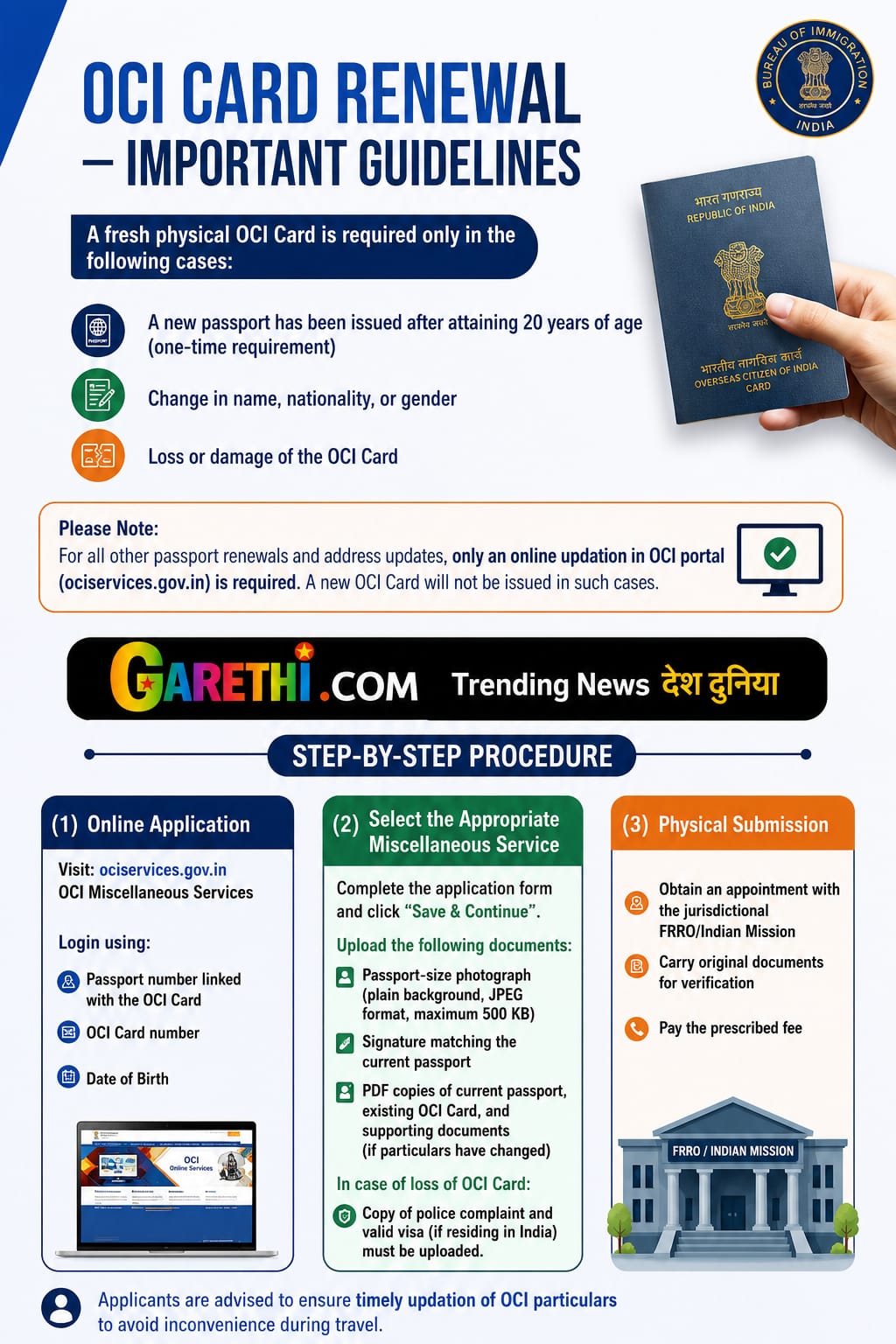
- These Misc services can be availed for re-issuance of OCI Card as well as updating the information time to time as mentioned in the MHA notification dated 16th April, 2021. The re-issuance of new OCI card will be applicable forfollowing categories.
- In case of issuance of new passport (once a new passport is issued after completing 20 years of age.) In case of change of personal particulars viz. name, father’s name, nationality etc.
- In case of loss/damage of OCI registration certificate
- In case change in address/occupation/contact details.
- In case of Renunciation of OCI Card.
- Aadhaar Card enrollment is presently available to residents in India. OCI Cardholders who stay in India for a long time (over 182 days in twelve months immediately preceding the date of application for enrolment) and have an Indian address can also enroll for Aadhaar Card in India. NRIs, although they are citizens of India, are not eligible for Aadhaar Card if they have not stayed for more than 182 days or more in the last 12 months. Upon completion of 182 days of their stay in India in the last 12 months immediately preceding the date of application for enrolment, NRIs can apply for Aadhaar Card.
- « As per Section 139AA of the Income-tax Act, 1961, every person who is eligible to obtain Aadhaar number shall, on or after the 1st day of July, 2017, quote Aadhaar number— (i) in the application form for allotment of permanent account number; (ii) in the return of income. The above provisions apply to persons who are eligible to get Aadhaar. Under section 3 of the Aadhaar Act, 2016, only a resident is entitled to get Aadhaar. Therefore, the provisions of Section 139AA quoted above regarding linking of Aadhaar to PAN or the requirement of quoting the Aadhaar number in the return shall not apply to a non-resident, who is not eligible to get Aadhaar.
- Overseas Indians Don’t Need Aadhaar for Mobile Connections:- Department of Telecom (DoT), Government of India has exempted overseas Indians from linking Aadhaar with their Indian connections and has issued suitable advisory to telecom service providers. DoT has issued a letter dated 01.12.2017 to all mobile phone service licensees to use alternative method to re-verify existing customers belonging to certain categories including foreigners (covering PIOs and OCI cardholders) and NRIs. Procedure and format for this purpose has been prescribed.
Major Changes in Overseas Citizen of India (OCI) System, Key Highlights
The Government of India has launched the Citizenship (New Amendment Act) Rules, 2026, bringing major reforms to the OCI system with a modern fully digital framework.
Fully Digital e-OCI Platform
All OCI applications, renewals, renunciations, and records are now processed through the new Online OCI Services Portal, replacing the old paper-based system.
PIO Cards Officially Invalid
PIO (Person of Indian Origin) cards are no longer accepted for travel to India. PIO cards became invalid from January 1, 2026.
Biometrics & Fast Track Immigration
Applicants must provide biometric consent during OCI registration. This enables integration with Fast Track Immigration systems at major Indian airports.
Residency Rule Removed
Foreign nationals applying from third countries no longer need to complete the earlier mandatory 6-month continuous stay requirement.
Appeal Rights Introduced
Rejected OCI applicants now have the right to appeal. Appeals will be reviewed by an authority one rank higher than the original decision-maker.
New Rule for Minor Children
Minor children cannot simultaneously hold an Indian passport and a foreign passport.

Conclusion
The new OCI reforms aim to create a faster, paperless, and more transparent immigration system while strengthening identity verification and global mobility for Overseas Citizens of India.
- CLICK HERE FOR OCI SERVICE’S https://ociservices.gov.in/onlineOCI/userRegistration


Er zijn veel digitale casino’s die spelers de beste casino zonder CRUKS, [url=https://assemamed.ly/2026/05/06/casino-s-zonder-cruks-vrijheid-in-spelletjes/]https://assemamed.ly/2026/05/06/casino-s-zonder-cruks-vrijheid-in-spelletjes/[/url] aanbieden. Deze websites zorgen voor een spannende speelervaring zonder restricties. Maak gebruik van geweldige selectie van spellen en voordelen. Het is belangrijk om jouw favoriete spellen te vinden en in gebruiken. Bezoek vandaag deze goede opties voor een uitmuntende tijd!
гей порно